


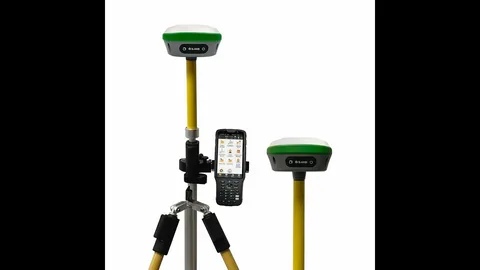
In today’s world, precise positioning has become critical in fields ranging from agriculture to construction and surveying. Traditional GPS systems often provide accuracy within a few meters, which is insufficient for applications requiring high precision. This is where rtk gps comes into play. In this article, we explore how RTK GPS achieves real-time centimeter accuracy, its working principles, and applications.
Understanding RTK GPS
RTK stands for Real-Time Kinematic, a satellite navigation technique used to enhance the precision of position data derived from standard GPS. Unlike conventional GPS, which relies solely on satellite signals, RTK GPS uses a network of base stations and correction signals to provide highly accurate positioning.
The Principle Behind RTK Accuracy
The key to understanding how RTK GPS achieves real-time centimeter accuracy lies in its use of carrier-phase measurements. Standard GPS uses code-phase signals, which offer meter-level accuracy. RTK GPS, however, measures the phase of the satellite’s carrier wave, which allows the system to detect much smaller positional changes.
Here’s a breakdown of the process:
- Base Station Setup: A fixed base station with a known location receives satellite signals and calculates errors in the GPS data.
- Transmission of Corrections: The base station sends these error corrections to the mobile receiver (rover) in real-time via radio or internet.
- Rover Adjustment: The rover applies the corrections to its own measurements, achieving centimeter-level accuracy almost instantly.
Real-Time Data Processing
Another reason RTK GPS achieves real-time centimeter accuracy is its real-time data processing capability. Unlike post-processed GPS, which calculates precise positions after data collection, RTK delivers immediate feedback, allowing operators to make accurate decisions on the spot. This real-time capability is especially useful in industries like precision agriculture, construction, and autonomous vehicle navigation.
Applications of RTK GPS
The precision of RTK GPS has opened up numerous applications:
- Agriculture: Ensures precise planting, fertilizing, and harvesting with minimal waste.
- Construction and Surveying: Facilitates accurate measurements and layout for large-scale projects.
- Autonomous Vehicles: Provides the high-precision positioning required for self-driving systems.
- Mapping and GIS: Enhances the accuracy of geographic information systems.
Conclusion
Understanding how RTK GPS achieves real-time centimeter accuracy demonstrates the transformative impact of this technology on multiple industries. By combining base station corrections, carrier-phase measurements, and real-time processing, RTK GPS provides a level of precision that traditional GPS cannot match, making it indispensable for any task requiring pinpoint accuracy.
